Thursday, December 18, 2008
Alien's
Just like I dont know if the Big Bang Thoery is entirely correct, I dont know if I believe in alien's. Its hard to imagine anything or anyone on another planet being alive other than us on earth. But scientist have found evidence to prove that there may be life on other planets or that there once was life on other planets. But the stories you hear about people spotting flying disks and seeing aliens doesnt make me believe in them. I think the only way I would ever believe in alien's is if I ever see one with my own eyes.

The Big Bang
I dont know if I believe in the big bang and the whole theory of the earth exploding into what it is now in less than a second. I dont think it is physically possible for the earth to form just like that. And I dont really think religion has anything to do with how the earth formed. Religion wasnt founded or invented until after the earth was here, so I dont know how religion would have anything to do with the forming of the earth.
I believe the earth was somehow put here, but i dont know how. Just like I dont know if I believe the whole Adam and Eve theory and how they were put on this earth, I really dont know how the earth could have just appeared in less than a second. I dont think it is possible.
I believe the earth was somehow put here, but i dont know how. Just like I dont know if I believe the whole Adam and Eve theory and how they were put on this earth, I really dont know how the earth could have just appeared in less than a second. I dont think it is possible.
Monday, December 15, 2008
Galaxy Hunter
Variability-
-Does the variability depend on a sample size?
As a sample size increases, range decreases, which means the variability decreases. At first, results rapidly become less variable, then the rate at which results become less variable slows down. As a larger and larger sample, variability keeps decreasing, but very slowly. The slow loss of variability continues until variability is zero at full size.
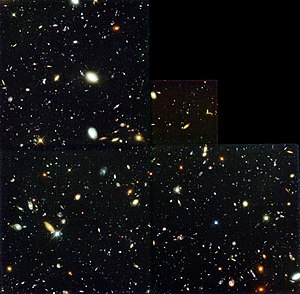
The galaxy images in the HDF's represent an earlier period in the history of the universe.
Billions and billions of galaxies populate the universe. The Hubble Space Telescope has unmasked many of them in two of the clearest, most distant views ever obtained, called the Hubble "Deep Fields" (HDF's). One view peers northward and the other peers southward.
Scientists have used math to unlock many galactic secrets hidden in these two views.
The Hubble Deep Field North is one of the deepest, sharpest, multi-color images of the faintest universe in visible light. The image was made by aiming the Hubble Space Telescope at one seemingly empty point in the northern sky near the Big Dipper for 10 days in December 1995. About a thousand never-before-seen galaxies are visible in this view of the universe.
The Hubble Space Telescope captured a dazzling assortment of never-before-seen galaxies. The Hubble Deep Field South complements the original Hubble Deep Field taken in late 1995. The constellation Tucana can only be viewed from the southern hemisphere. The 10-day-long observation doubled the number of far-flung galaxies available.
Tuesday, December 2, 2008
Annie Cannon and her spectra
If I could spend the rest of my life doing anything, I would help other people. If i could be a doctor, dentist, psycholigist, etc., I would. I like helping people and knowing I made an impact on their lives. I want them to know that I care about them and I would want them to know that I want them to be able to achieve anything they set their minds to. Plus I would go down in history as the only person that was able to be all those things in one! :D
Subscribe to:
Posts (Atom)