1. Distinguishes between an event horizon and an accretion zone of a black hole:
An accretion zone has matter that lingers close to the black hole and spirals inward to form the black hole. Gas and dust particle collide with each other and spin around the hole. An event horizon is a hole that traps things in it forever. Light, dust and other things that get trapped in it can never escape. The event horizon is the imaginary sphere around the black hole.
2. Defines escape velocity, black hole, and the speed of light.
-Speed of Light: The speed of light is a constant in empty space.
-Escape Velocity- Velocity that an object needs to escape the gravitational well of a more massive object.
-Black Hole: An object so dense that light cannot escape from it.
3. Explains the relationship between escape velocity, black hole, and the speed of light.
The event horizon is an imaginary sphere around the black hole where the escape velocity is greater than the speed of light. Once anything crosses the event horizon, nothing, not even light, can escape. When material crosses the event horizon, the mass of the black hole increases, which boosts the black hole's gravitational force and expands its event horizon — the point of no return.
4. Identifies more than one single type of black hole.
Event Horizon and Escape Velocity
5. List evidence that our understanding of black holes has changed.
Miniature black holes might have been created during the Big Bang Theory. The miniature black holes have event horizons as small as the width of an atomic particle. Between 10 and 20 billion years ago, all matter and energy was compressed into a single point. Then this tiny point exploded (the Big Bang) and expanded rapidly.
6. Explain how Hubble Space Telescope's component cameras assist in the search for black holes.
Hubble is a telescope that orbits Earth. Its position above the atmosphere, which distorts and blocks the light that reaches our planet, gives it a view of the universe that typically far surpasses that of ground-based telescopes.
7. List at least 2 myths about black holes that are discredited.
-The volume of a black hole approaches zero. As volume decreases, density increases. Density is the relationship of mass per unit of volume (Density = Mass/Volume). The density of a black hole affects the escape velocity of an object — even light.
- Black holes have a broad range of masses — from the smallest (miniature) to the largest (supermassive).
Wednesday, November 26, 2008

Wednesday, November 19, 2008
The Ghost Particle
1. What is a neutrino and how was it first proposed?
-A neutrino particle travels close to the speed of light, lacks an electric charge, are able to pass through ordinary matter almost undisturbed and are thus extremely difficult to detect.
2. Evidence:
3.What does radioactivity have to do with the sun?
4. What did John Bahcall do?
-He is best known for his contributions to the solar neutrino problem and the development of the Hubble Space Telescope.
5. Ray Davis was trying to create an experiment where neutrinos changed chlorine to argon atoms. Where was his setup located?
-A neutrino particle travels close to the speed of light, lacks an electric charge, are able to pass through ordinary matter almost undisturbed and are thus extremely difficult to detect.
2. Evidence:
3.What does radioactivity have to do with the sun?
4. What did John Bahcall do?
-He is best known for his contributions to the solar neutrino problem and the development of the Hubble Space Telescope.
5. Ray Davis was trying to create an experiment where neutrinos changed chlorine to argon atoms. Where was his setup located?
Thursday, November 13, 2008
Killer Solar Flares
I dont think in 2012, we are going to have "Killer Solar Flares" that cause the earth to explode, and all the people living on the earth to die. Just because the Aztecs calendar doesnt go pass 2012, doesnt mean the world's going to stop. Everyone thought the world was going to end in 2000 after the millenium, but nothing happened. I think its the same with the world ending in 2012. Its just a myth.
The World of Plate Tectonics
Pangaea:
The Pangaea theory is one that states that all present continents were once together and collectively known as a 'supercontinent' called a Pangaea. Because of Pangaea, we have seperate countries like england and australia and all the other countries around the world.
Sea floor spreading:
Sea-floor spreading is the process in which the ocean floor is extended when two plates move apart. As the plates move apart, the rocks break and form a crack between the plates. Earthquakes occur along the plate boundary. Magma rises through the cracks and seeps out onto the ocean floor like a long, thin, undersea volcano.
Plate boundaries:
Plate boundaries are found at the edge of the lithospheric plates and are of three types, convergent, divergent and conservative. Wide zones of deformation are usually characteristic of plate boundaries because of the interaction between two plates. The three boundaries are characterized by their distinct motions.
The Ring Of Fire:
The "Ring of Fire" is an arc stretching from New Zealand, along the eastern edge of Asia, north across the Aleutian Islands of Alaska, and south along the coast of North and South America. The Ring of Fire is composed over 75% of the world's active and dormant volcanoes.
Mid-Ocean Ridge:
The Mid-Ocean Ridge system is more than 56,000 kilometers (35,000 mi) long. This series of mountains and valleys marks where the Earth’s crustal plates are moving apart. This is where most hydrothermal vents are located.
Shifting North and South Poles:
In 2012 the next polar reversal will take place on earth. This means that the North Pole will be changed into the South Pole. Scientifically this can only be explained by the fact that the earth will start rotating in the opposite direction, together with a huge disaster of unknown proportions.
2. What do volcanoes on the Moon and Mars tell us about those planets?
They tell us that there are tectonic plates located on Mars and the Moon that are forming those volcanoes.
3.
DUBO -- Latitude: -4.26 mm/yr. Longitude: -17.30 mm/yr.
HILO -- Latitude: 35.87 mm/yr. Longitude: -62.83 mm/yr.
KELY -- Latitude: 11.23 mm/yr. Longitude: -17.66 mm/yr.
HOFN -- Latitude: 14.87mm/yr. Longitude: 13.09 mm/yr.
The Pangaea theory is one that states that all present continents were once together and collectively known as a 'supercontinent' called a Pangaea. Because of Pangaea, we have seperate countries like england and australia and all the other countries around the world.
Sea floor spreading:
Sea-floor spreading is the process in which the ocean floor is extended when two plates move apart. As the plates move apart, the rocks break and form a crack between the plates. Earthquakes occur along the plate boundary. Magma rises through the cracks and seeps out onto the ocean floor like a long, thin, undersea volcano.
Plate boundaries:
Plate boundaries are found at the edge of the lithospheric plates and are of three types, convergent, divergent and conservative. Wide zones of deformation are usually characteristic of plate boundaries because of the interaction between two plates. The three boundaries are characterized by their distinct motions.
The Ring Of Fire:
The "Ring of Fire" is an arc stretching from New Zealand, along the eastern edge of Asia, north across the Aleutian Islands of Alaska, and south along the coast of North and South America. The Ring of Fire is composed over 75% of the world's active and dormant volcanoes.
Mid-Ocean Ridge:
The Mid-Ocean Ridge system is more than 56,000 kilometers (35,000 mi) long. This series of mountains and valleys marks where the Earth’s crustal plates are moving apart. This is where most hydrothermal vents are located.
Shifting North and South Poles:
In 2012 the next polar reversal will take place on earth. This means that the North Pole will be changed into the South Pole. Scientifically this can only be explained by the fact that the earth will start rotating in the opposite direction, together with a huge disaster of unknown proportions.
2. What do volcanoes on the Moon and Mars tell us about those planets?
They tell us that there are tectonic plates located on Mars and the Moon that are forming those volcanoes.
3.
DUBO -- Latitude: -4.26 mm/yr. Longitude: -17.30 mm/yr.
HILO -- Latitude: 35.87 mm/yr. Longitude: -62.83 mm/yr.
KELY -- Latitude: 11.23 mm/yr. Longitude: -17.66 mm/yr.
HOFN -- Latitude: 14.87mm/yr. Longitude: 13.09 mm/yr.
Killer Asteroids
I tried downloading the video, but it wouldn't work.
The video was about how all the meteors circle around space on the asteroid belt between mars and jupiter. Rock and metal left over from building the solar system, for the metoer, which circles around the belt. When they collide, they are sent flying out of the orbit of the belt at 20 kilometers a second. At that speed, an asteroid could hit the earth hard enough to do major damage.
The video was about how all the meteors circle around space on the asteroid belt between mars and jupiter. Rock and metal left over from building the solar system, for the metoer, which circles around the belt. When they collide, they are sent flying out of the orbit of the belt at 20 kilometers a second. At that speed, an asteroid could hit the earth hard enough to do major damage.
Wednesday, November 12, 2008
Spaceweather and Asteroids
I wouldnt spend alot of time worrying about asteroids. With all the technology we have we can early detect if one is coming towards us, where its going to hit and when its going to hit. And we probably have enough technology now to prevent an asteroid from hitting us. I really have dont think in my lifetime, I will ever see/hear of an asteroid hitting this earth.
TUNGUSKA: I think it might be harder to detect an explosion. In research I found about Tunguska, it said that the meteor was only 30 kilometers away from the earth before it exploded, so that might be harder to detect. If its just falling from orbit and is going to hit the earth, thats one thing, but you dont have a meter or anything on the meteor to actually detect whats going on inside, so it would be harder to tell if something were to explode or not.
Shoemaker Levy-9: This would be much easier to tell whether or not something was going to hit another planet. There's satellites and cameras and all types of things in space that would tell you if something was headed for another planet. But i dont think anything could be done to stop the meteor if it were going to hit.
TUNGUSKA: I think it might be harder to detect an explosion. In research I found about Tunguska, it said that the meteor was only 30 kilometers away from the earth before it exploded, so that might be harder to detect. If its just falling from orbit and is going to hit the earth, thats one thing, but you dont have a meter or anything on the meteor to actually detect whats going on inside, so it would be harder to tell if something were to explode or not.
Shoemaker Levy-9: This would be much easier to tell whether or not something was going to hit another planet. There's satellites and cameras and all types of things in space that would tell you if something was headed for another planet. But i dont think anything could be done to stop the meteor if it were going to hit.
Wednesday, November 5, 2008
I liked to see how small the earth really is compared to the other planets around us. To humans, the earth is huge and goes on forever, but in reality, the earth is one of the smallest planets in the solar system. Some of the other planets are 10x bigger! But they look alot smaller to us because they are millions of miles away.
Ray Davis/John Bahcall

Ray Davis/John Bahcall-
John Bahcall, theorist, and Raymond Davis, Jr., experimentalist, are the scientists most responsible for the field of solar neutrino physics and neutrino astronomy. While contributions to nuclear physics and astrophysics are numerous and varied, this award honors their contribution to fundamental physics-the probable determination that the neutrino has a nonzero rest mass. Bahcall's calculations and Davis's experiments have proved that the sun is definitely powered by nuclear fusion reaction, and that electron neutrinos oscillate into many "flavors" on their way from the sun to the earth.
S. Chandrasekhar

S. Chandrasekhar(1910-1995)-
Indian astrophysicist who studied at Cambridge, then moved to America and the University of Chicago. He has contributed significantly to many disparate branches of physics, including rotational figures of equilibrium, stellar interiors, black holes, radiative transfer, hydromagnetic stability, stellar dynamics, and many others. Chandrasekhar's name is immortalized in connection with the Chandrasekhar limit, which is the largest mass a white dwarf can attain. The theory underlying this result was viciously attacked by Eddington, who used nonsensical and contradictory arguments to try to show it invalid.
Arno Penzias/Robert Wilson
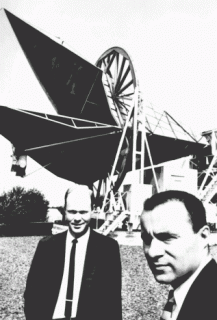
Arno Penzias/Robert Wilson-
Like many of science's greatest discoveries, the one that earned Arno Penzias his Nobel Prize was an event of pure serendipity. While tuning a small, yet very powerful and highly sensitive horn antenna for conducting radio astronomy experiments, Arno Penzias and Robert Wilson noted a constant low level noise disrupting their reception. Despite their efforts, Penzias and Wilson could not find any evidence of malfunction in their equipment. Further, the static persisted regardless of the direction the antenna was pointing. As they continued their investigation, Penzias and Wilson came to realize that they had stumbled onto the most conclusive evidence to date supporting the Big Bang Theory. Working in 1965, Penzias and Wilson were not looking for evidence of the Big Bang. However, by this time astronomers had begun to speculate about the conditions at the beginning of the universe. An explosion of such size and temperature to bring the universe into being must have left some mark. As Penzias and Wilson continued to pursue their disruptive "static," they came to realize that they had discovered the remnants of this first cataclysm. This work has since been expanded by George Smoot, who in 1992 announced that he had discovered temperature differences in the radiation.
Annie Cannon

Annie Cannon-
Born: Dover, Delaware, December 11, 1863
Died: Cambridge, Massachusetts, April 13, 1941
Died: Cambridge, Massachusetts, April 13, 1941
It was left to Annie Jump Cannon to continue, beginning with an examination of bright southern hemisphere stars. To these she applied yet a third scheme, derived from Fleming's and Maury's, an "arbitrary" division of stars into the spectral classes O, B, A, F, G, K, M, and so on. It was as "theory-laden" as Maury's ordering, but greatly simplified. Her "eye" for stellar spectra was phenomenal, and her Draper catalogs (which ultimately listed nearly 400,000 stars) were valued as the work of a single observer.
Clyde Tombaugh

Clyde Tombaugh-
Clyde Tombaugh was born in 1906 to an Illinois farm family. He received an offer to come to Lowell to work as a junior astronomer. Clyde accepted the job and joined the search for Percival Lowell's "Planet X", a planet beyond Neptune. Clyde Tombaugh's job was to photograph one small piece of the night sky at a time. He then had to carefully examine and compare the photos in an effort to detect an unidentified moving point of light that might be a planet. Clyde Tombaugh photographed 65% of the sky and spent thousands of hours examining photographs of the night sky. After ten months of very hard work, sometimes working through the night in an unheated dome, Clyde Tombaugh discovered an object he named Pluto. For many years, Pluto was considered to be the ninth planet in our solar system. However, as astronomers learned more about the planets and also about a new group of objects known as the Kuiper Belt Objects, it became clear that Pluto was more like the objects in that belt than the other eight planets. In August 2006, Pluto was re-classified as a dwarf planet.
Clyde Tombaugh died at the age of ninety on January 17, 1997.
Clyde Tombaugh died at the age of ninety on January 17, 1997.
Johannes Kepler

Johannes Kepler-
Johannes Kepler was born on December 27, 1571, in Weil der Stadt, Württemburg, in the Holy Roman Empire of German Nationality. Johannes Kepler died in Regensburg in 1630. He thought this might be the key to the solar system. He truly believed in the Copernican system, so he saw the planetary orbits as six concentric circles. A natural question to ask is: why did the Creator make the orbits the particular sizes they are? He felt the universe would somehow show mathematical beauty or symmetry. Arguing in a way that Pythagoras and Plato would have sympathized with, he suggested that the orbits might be arranged so that regular polygons (triangles, squares, etc.) would just fit between adjacent ones, and maybe somehow this reflected some invisible underlying structure holding it all together. Disappointingly, he found it just didn't work out---the ratios were wrong. Then he had a real inspiration. The universe was really three-dimensional, and instead of thinking about circles, he should be thinking about spheres, with the planetary orbits being along the equators. Thinking in three dimensions, the analogue of the above diagram would be two concentric spheres with a tetrahedron between them, so that the outer sphere passes through the vertices of the tetrahedron, and the inner sphere touches all its sides, but is completely contained in the tetrahedron. Now came the really exciting part-there were just six planets, so five spaces between spheres, and there are just five regular solids! Thus, if the distances came out right, the theory provided a complete explanation, in terms of an elegant geometric model, of why there are just six planets, and why they are spaced as we find them. Actually, the distances still don't come out right, especially for Jupiter, but Kepler was so sure of the rightness of his scheme, that he blamed the discrepancies on errors in Copernicus' tables. He modestly titles his work Mysterium Cosmographicum--the mystery of the universe (explained). The crucial illustration from his book is shown below, the outer sphere being the orbit of Saturn, and the central part is shown magnified at top right.
Albert Einstein

Albert Einstein-
He was born at Ulm, in Württemberg, Germany, on March 14, 1879. At the start of his scientific work, Einstein realized the inadequacies of Newtonian mechanics and his special theory of relativity stemmed from an attempt to reconcile the laws of mechanics with the laws of the electromagnetic field. He dealt with classical problems of statistical mechanics and problems in which they were merged with quantum theory: this led to an explanation of the Brownian movement of molecules. He investigated the thermal properties of light with a low radiation density and his observations laid the foundation of the photon theory of light. He also received the nobel prize.
Edwin Hubble

Edwin Hubble-
He was born in the small town of Marshfield, Missouri, USA, on November 29th, 1889. Hubble had devised a classification system for the various galaxies he observed, sorting them by content, distance, shape, and brightness; it was then he noticed redshifts in the emission of light from the galaxies, seeing saw that they were moving away from each other at a rate constant to the distance between them. From these observation, he was able to formulate Hubble's Law in 1929, helping astronomers determine the age of the universe, and proving that the universe was expanding.
Subscribe to:
Posts (Atom)